













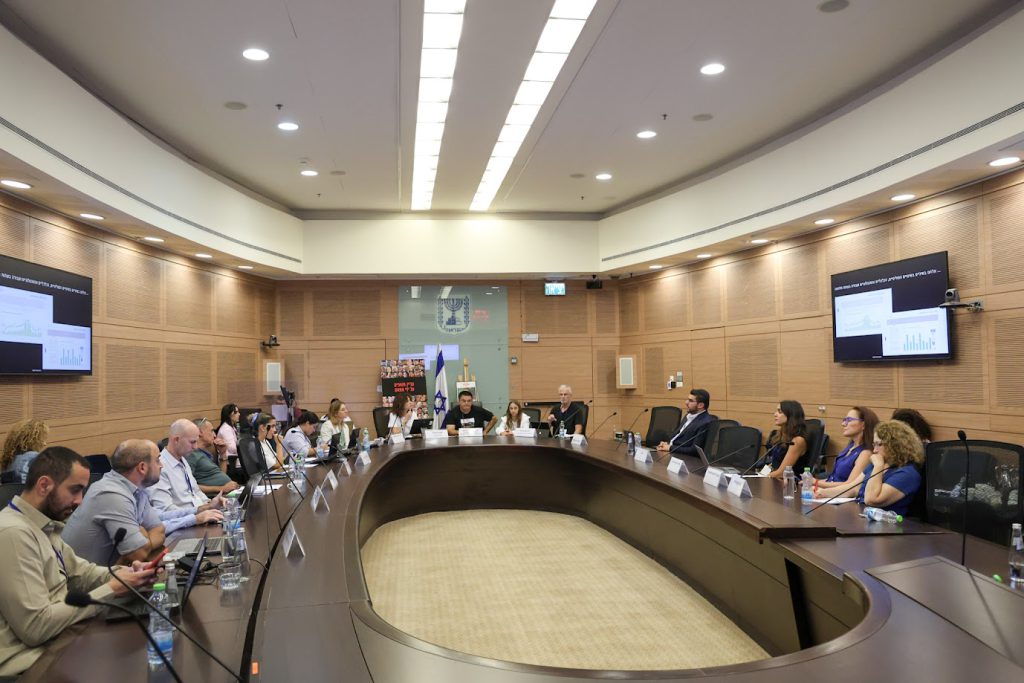
The Special Committee for Oversight of Barrier Removal Processes, chaired by MK Michael Biton (Blue and White—National Unity Party), held on Tuesday a follow-up debate on the national plan for increasing human capital in the high-tech industry, with the participation of the Dadi Perlmutter, chair of the Inter-Ministerial Committee for Increasing Human Capital in High-Tech.
Perlmutter presented the main findings of the committee’s report, and said “High-tech is a central economic anchor supporting the Israeli economy, especially during times of war, and accounts for 56% of exports. In the first quarter of 2025, the high-tech sector’s GDP grew by 11.8%, compared to a 1.5% growth rate of the Israeli economy as a whole.”
He further emphasized the importance of increasing human capital for tech jobs and strengthening the high-tech sector. “This is a national mission to strengthen Israel’s security, economy, and social mobility. These days it is clear that Israel’s security depends on science and technology. The skills that will be required in the future will be dramatically different from today,” he said.
“The high-tech sector is composed of 63.5% Jewish men and 32% non-Haredi Jewish women, most of whom live between Hadera and Gedera. Eighty-seven percent of high-tech workers have passed the five-unit English matriculation exam. The main conclusion of the report is that the focus must be on developing ‘tech skills’—including in artificial intelligence—not only in the traditional high-tech sector. Therefore, the education system should promote tech-oriented matriculation tracks, especially in the periphery and Arab society, and develop informal education to encourage girls to study technology. There is a need to update undergraduate curricula, incorporate practical training, foster independent learning skills, and strengthen English proficiency,” Perlmutter told the committee.
Naor Gonen of the Ministry of Innovation, Science and Technology stated that 68% of high-tech plants and companies are located in Tel Aviv and its surroundings, compared to 53% in other sectors of the economy. Committee Chair MK Biton said in response: “These numbers show that millions of Israelis are not part of the high-tech boom, and that needs to be corrected.”
Sivan Noyfeld, Business Development Manager at the Israeli High-Tech Association, said “We are in the midst of a digital revolution, but the education system is not keeping up. The gap between what is taught in classrooms and what is needed in the job market is growing, and this gap is not just technological—it is also economic and social. This is a national challenge. At the Israeli High-Tech Association, we are calling for a paradigm shift: the education system must stop working alone and start collaborating with the industry. The curriculum needs to be updated and adjusted to real market needs, and engineers, researchers, and professionals should already be incorporated in the classrooms. This is not just in the interest of the high-tech sector; it is in the interest of the entire economy, society, and our children. Human capital is the only resource we have—and we must invest in it now.”
Prof. Michal Armoni of the Weizmann Institute of Science said, “We cannot rely solely on high-tech professionals coming to teach. The most important investment is in training teachers.”
Illan Freedman, policy advocate at the Arlozorov Forum, said “High-tech is not a goal but a tool. Advanced manufacturing industries have the potential to create more jobs. Currently, a significant part of the industry is being outsourced abroad, and we are missing out on workers, especially from the periphery.”
Perlmutter added: “If you do not develop human capital, from early childhood to retirement, you have no future. We must create fertile ground so that foreign investors will continue to invest here—and that is the responsibility of the Government of Israel.”
Committee Chair MK Biton summarized the meeting: “We are facing a profound challenge of lack of diversity in human capital within the high-tech industry—not only in geographic peripheries like the Negev and Galilee, but also in social, educational, and economic peripheries. Real progress and inclusive growth will only be achieved by adopting a systemic policy that brings all sectors—Arabs, Haredim, Ethiopian Israelis, and others—into the heart of the industry. This is not a matter of social justice, but a strategic interest of the State of Israel. Therefore, the goal is not only to increase the number of workers in high-tech, but to expand diversity and opportunity. To achieve this, we must act with initiative and creativity to fully realize the human capital that exists here. We have made progress, but the road ahead is still long. Much work remains—and ultimately, it depends on the Government.”